Voice of the customer (VoC) is the practice of capturing what customers say about your product, in their own words, from every channel, then analysing it and acting on it. A working VoC program does four things: it captures feedback where it happens (calls, emails, tickets, reviews, surveys, feedback boards), groups it into themes linked to real customers, ranks those themes by how many customers ask and how much revenue they represent, and closes the loop by telling customers what changed. Tools like Murmur use AI to do the capturing and grouping for you.
Every company hears from customers. Few can answer simple questions about what they hear: which request came up most this quarter, which customers asked, and how much revenue sits behind it. Closing that gap is what a voice of the customer program is for.
What is voice of the customer?
The practice of capturing what customers say about your product, in their own words, from every channel, then analysing it and acting on it.
The phrase comes from quality management, where teams wrote customers' exact words down before translating them into requirements. The idea still holds: the verbatim comes first. "Make reporting better" is an interpretation. "I export to Google Sheets every Monday because your charts can't filter by region" is the voice of the customer, and it tells you what to build.
Why VoC matters, especially in SaaS
SaaS runs on recurring revenue, so what happens after the sale matters as much as the sale. A VoC program in a SaaS company is the system that connects what customers say to churn, activation and expansion:
- Lower churn. Cancellation reasons and renewal conversations show what would have kept a customer.
- Faster activation. Onboarding feedback shows where new users get stuck before their first win.
- More expansion. Requests from your best accounts point to what they would pay more for.
- You build what keeps customers. Requests tied to real accounts beat guesses about what the market wants.
- You stop over-serving the loudest voice. Counting every mention, not just the latest escalation, shows what is common.
- Sales, support and product share one picture. The same list answers "is this on the roadmap?" for everyone.
- Customers notice. When people hear back about what they asked for, they keep telling you things.
VoC methods and sources
Voice of the customer data comes in two kinds. Solicited feedback is what you ask for: surveys, interviews, NPS. Unsolicited feedback is what customers say anyway: support tickets, sales calls, reviews, community posts. Unsolicited feedback is usually more specific and more honest, and it is also the part most teams lose.
| Source | What it tells you | How to capture it |
|---|---|---|
| Customer interviews | Why customers behave as they do | Notes or transcripts, tagged by theme |
| Surveys and NPS | How many customers feel a certain way | Survey tool, open-text answers analysed |
| Support tickets | Where the product breaks or confuses | Forward or sync tickets, extract requests |
| Sales and success calls | What blocks deals and renewals | Call notes forwarded, linked to the account |
| Reviews (G2, app stores) | What prospects read before buying | Regular export, grouped by theme |
| Feedback board and widget | What customers want next, with votes | Public board with signed-in voting |
| Slack, Discord, community | Raw reactions in real time | Capture threads into requests |
| Product analytics | What customers actually do | Usage and adoption next to the feedback |
| Cancellation and win/loss | Why customers leave or choose a competitor | Short exit survey, deal notes |
The strongest programs combine three signals: what customers say (feedback), what they do (usage), and what it is worth (revenue and renewal). A loud request from an account that never uses the feature reads differently from a quiet one from your biggest customer.
How to run a VoC program in 6 steps
Start small: a lightweight 90-day program focused on one question beats a company-wide survey project that never ships.
- Pick an owner and a question. One person owns the program. Start with a question you need answered, such as "what should we build next quarter?"
- List your channels. Write down every place feedback arrives today. Most teams find six or more.
- Capture it in one place. Forward emails, connect chat, add a feedback board and widget. Every item keeps the customer's exact words and a link to who said it.
- Group and deduplicate. Ten people asking for "Sheets export", "CSV download" and "get my data out" are one request with ten voters.
- Rank by customers and revenue. Count distinct customers and add up the revenue they represent. Then decide.
- Close the loop. Tell everyone who asked when an idea is planned, started and shipped, then measure whether churn, activation or expansion moved. Our guide on how to close the customer feedback loop has templates.
Who owns what
| Team | Role in the VoC program |
|---|---|
| Program owner | Runs the process, the readout and the follow-through |
| Product | Turns themes into discovery and roadmap decisions |
| Support | Flags recurring friction and bugs |
| Sales and success | Brings in blockers, renewal risks and customer language |
| Leadership | Settles trade-offs and holds teams to the plan |
In a team of five, one person can wear most of these hats. What matters is that someone owns the loop end to end.
How to analyze customer feedback (with AI)
Customer feedback analysis used to mean a spreadsheet, a tagging scheme and an afternoon a month. The work is mostly reading, matching and counting, which is exactly what language models are good at. A modern workflow looks like this:
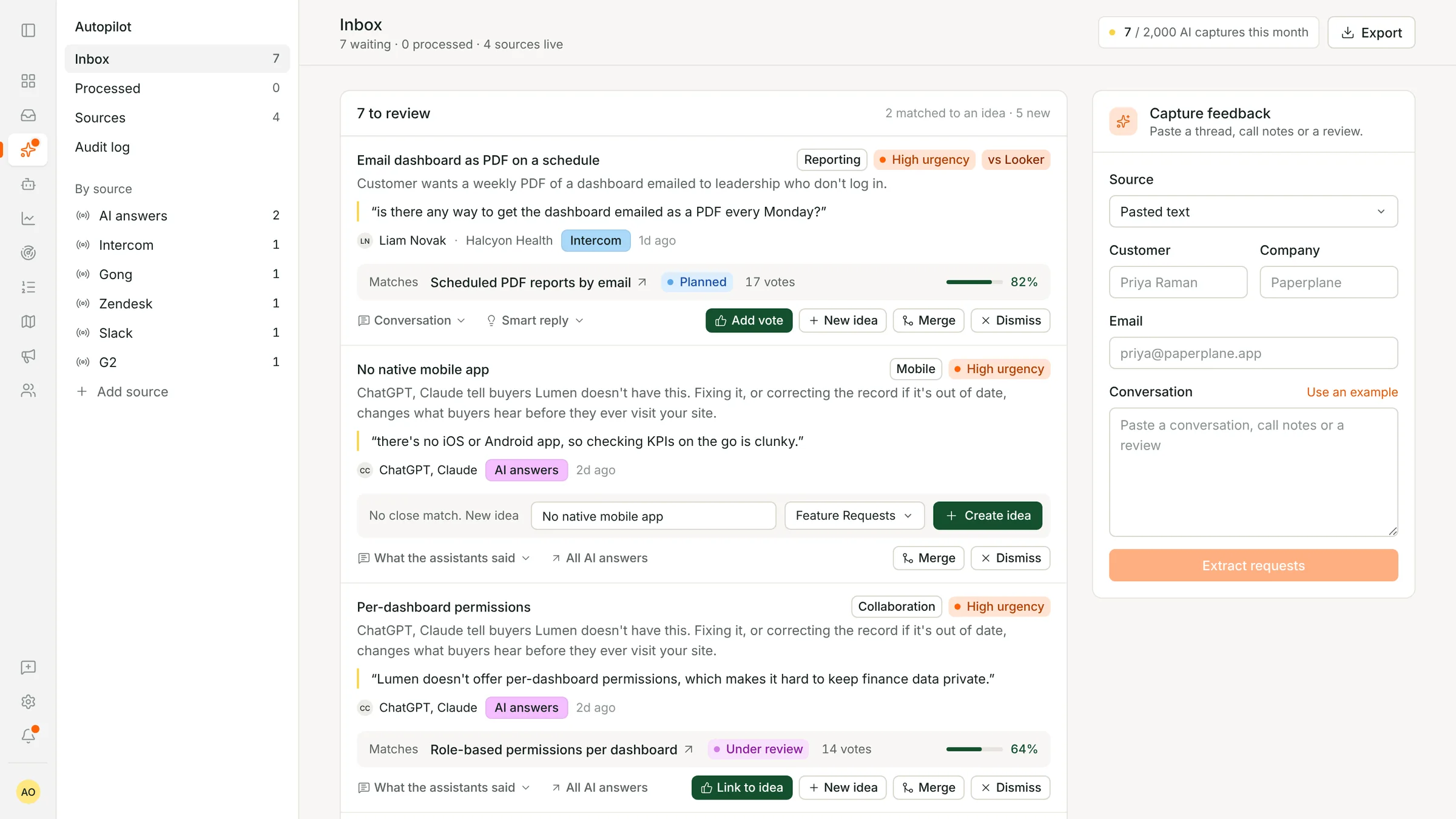
- Extract. AI reads each email, ticket or call note and pulls out the distinct requests in it. One email can hold three.
- Match. Each request is compared with ideas you already track. A match adds a vote; a new request becomes a new idea.
- Attribute. The request is linked to the customer and their company, so revenue rolls up to the idea.
- Review. A person approves or edits each suggestion. AI does the reading; you make the call.
This is what Murmur's Autopilot does. Forward an email (or, on Team, connect Slack and Discord) and Autopilot finds the requests, links the customer, and matches each one to an existing idea or proposes a new one, waiting in an inbox for your approval.
A voice of the customer template
Whatever tool you use, every piece of VoC should carry the same fields. Copy this into a sheet if you are starting from zero:
| Field | Example | Why it matters |
|---|---|---|
| Verbatim | “We export to Sheets every Monday.” | The customer's words, not your summary |
| Customer and company | Grace, Fieldnote | Lets you go back and ask |
| Revenue | $2,400 MRR | Weights the request by value |
| Source | Sales call, 14 March | Shows where demand shows up |
| Request | Google Sheets as a data source | The theme it rolls up to |
| Importance | Must have | Separates nice-to-haves from blockers |
| Status | Planned | Drives the update you send back |
Voice of the customer examples
The numbers below are illustrative, but the patterns are typical of B2B SaaS teams.
- The quiet blocker. Support sees four tickets a month about exporting data. Sales notes show the same need in three lost deals. Neither team knew the other was hearing it. Grouped together, it is the most valuable request on the board.
- The loud minority. A vocal customer posts the same request in Slack every week. VoC data shows two customers asking, both on the smallest plan. It waits, and the team can say why.
- The review theme. Three recent reviews mention a confusing setup step. Nobody filed a ticket. The fix takes a day and shows up in the next round of reviews.
How to present voice of the customer data
Executives and engineers both want the same thing: a short list and a recommendation. A one-page VoC readout works well:
- The decision you need, in one sentence.
- The top three to five themes, each with customer count, revenue and a trend.
- Two or three verbatim quotes per theme, with the customer's name and company.
- What you propose to build, and what you are choosing not to.
- How and when you will tell the customers who asked.
Voice of customer tools
VoC tools fall into three groups, and many companies use one from each:
| Type | Examples | Best at |
|---|---|---|
| Survey and experience platforms | Qualtrics, Medallia, InMoment | Large-scale surveys and CX measurement |
| Feedback management | Murmur, Canny, Featurebase | Capturing requests, ranking by votes and revenue, closing the loop |
| Support and conversation analytics | Help desk reporting, call recorders | Spotting themes inside tickets and calls |
For a SaaS team of one to ten people, a feedback management tool usually covers most of a VoC program on its own. Murmur captures requests from email (and from Slack and Discord on Team), keeps a public board and widget where customers vote, shows the company and MRR behind every vote, and emails voters when status changes. See how it fits a voice of customer program, or compare the best customer feedback software.
VoC vs CX vs CRM
| What it is | Question it answers | |
|---|---|---|
| VoC | What customers say, in their words | What do customers want and why? |
| CX | How customers experience every interaction | How does it feel to be our customer? |
| CRM | The record of accounts, contacts and deals | Who are our customers and what are they worth? |
They work best together. VoC tells you what to change, CX tells you whether the change landed, and CRM data tells you whose voice carries the most revenue. Murmur brings the last part in through its widget, which passes each customer's company and MRR with their vote.
Frequently asked questions
What is the voice of the customer?
Voice of the customer (VoC) is the structured practice of capturing customers' feedback in their own words, from interviews, surveys, support tickets, sales calls, reviews and feedback boards, analysing it for themes, and using it to decide what to build, fix or change.
What is a voice of the customer program in SaaS?
In a SaaS company, a VoC program is a repeatable system for capturing feedback across the customer lifecycle, from onboarding and support to renewal and cancellation, combining it with usage and revenue data, and acting on it to reduce churn, improve activation and grow expansion revenue.
What is a VoC program?
A VoC program is the repeatable process a company uses to collect, analyse and act on customer feedback. It names who owns the feedback, which channels are captured, how requests are ranked, and how customers are told what changed.
What are examples of voice of the customer?
Common examples are a support ticket asking for a CSV export, a sales call where a prospect says they need single sign-on before buying, a one-star review mentioning slow load times, an NPS comment, and a feature request with votes on a public feedback board.
What are voice of customer tools?
VoC tools collect and analyse customer feedback. They fall into three groups: survey and experience platforms such as Qualtrics and Medallia, feedback management tools such as Murmur and Canny that capture requests and rank them by votes and revenue, and analytics tools that tag themes in tickets and reviews.
How do you analyze customer feedback?
Bring feedback from every channel into one place, link each piece to the customer who said it, group it into themes or feature requests, merge duplicates, then rank themes by the number of customers and the revenue behind them. AI can do the extraction, matching and grouping, leaving people to make the decisions.
How do you present voice of customer data?
Lead with the decision you need, then show the top three to five themes with the number of customers, the revenue they represent and two or three verbatim quotes each. End with what you propose to do and how you will tell customers.
What is the difference between CX and CRM?
Customer experience (CX) is how customers feel about every interaction with your company. Customer relationship management (CRM) is the system and process for tracking accounts, contacts and deals. VoC feeds CX by telling you what customers think, and CRM data tells you which of those customers matter most to revenue.
Is VoC the same as NPS?
No. Net Promoter Score is one survey question that measures loyalty. It can be a VoC source, but a VoC program also captures the unprompted feedback in calls, tickets, emails and reviews, which is usually where specific requests come from.
Collect it, rank it, ship it, tell everyone
Murmur is customer feedback software for small SaaS teams: a feedback portal and widget, AI that captures requests from email, revenue on every vote, and emails to every voter when you ship. Free for one board with unlimited voters.