The best customer feedback software for most SaaS teams is a feedback management tool that captures requests from every channel, ranks them by votes and revenue (revenue-weighted prioritization), and tells customers when something ships. Murmur does all three at a flat price: free for one board with unlimited voters, then $19 a month for Solo. Canny and Featurebase are strong alternatives priced per tracked user or per seat, Productboard and UserVoice suit large organisations, and survey tools such as Survicate, Typeform or Hotjar are the right pick when you need NPS, CSAT or answers to questions you choose. Many startups pair one feedback board with one survey tool.
Search for customer feedback software and you will find survey platforms, review tools, help desks and feedback boards all on the same list. They solve different problems. This guide sorts them out, then ranks the ten tools we would shortlist for a SaaS team in 2026.
We make Murmur, which is on this list. Prices come from each vendor's pricing page in October 2026, and every entry says who it suits best, including when that is not us.
What is customer feedback software?
Software that collects what customers say about your product, organises it into requests linked to real customers, helps you decide what to act on, and tells customers what changed.
The last part is the one most tools skip. Collecting feedback is easy; a shared inbox does it. The value is in turning hundreds of messages into a short, ranked list, and then letting the people who asked know you listened.
Types of customer feedback tools
| Type | What it does | Examples |
|---|---|---|
| Feedback boards and portals | Customers post ideas, vote and follow a roadmap | Murmur, Canny, Featurebase, Frill |
| In-app feedback widgets | Collect feedback without leaving your product | Murmur, Canny, Sleekplan |
| Survey and NPS tools | Ask questions you choose, at moments you choose | Typeform, SurveyMonkey, Hotjar |
| Experience platforms | Enterprise CX and VoC measurement | Qualtrics, Medallia |
| Product management suites | Specs, roadmaps and insights for big teams | Productboard |
How to choose a customer feedback tool
Check every candidate against these six questions:
- Can it capture feedback where it already arrives? Email, chat and calls hold most requests. Without capture, your board only shows what customers bothered to post.
- Does it merge duplicates? The same request in five wordings should be one idea with five voters.
- Does every vote carry the customer and their revenue? Votes alone over-weight free users. Revenue-weighted prioritization fixes that.
- Does the price grow with voters? Per-voter pricing punishes a board that works.
- Does it close the loop? Look for automatic emails to every voter when status changes.
- What happens after you decide? If you build with Claude Code or Cursor, an MCP server or a path to a pull request saves hours.
Customer feedback software at a glance
| Tool | Type | Entry price | Free plan | Pricing model |
|---|---|---|---|---|
| Murmur | Board, portal, widget, AI capture | $19 a month | Yes | Flat, unlimited voters |
| Canny | Board, portal, widget, AI capture | $79 a month, yearly | Up to 25 tracked users | Per tracked user |
| Featurebase | Feedback plus help desk | $29 per seat a month, yearly | 1 seat, no AI | Per seat, plus usage |
| Sleekplan | Board, roadmap, changelog | $13 a month, yearly | Yes | Per workspace |
| Frill | Board, roadmap, announcements | $25 a month | No | Flat, by tier |
| Productboard | Product management suite | On request | No | Per maker, minimum 5 |
| UserVoice | Enterprise feedback | On request | No | Not public |
| Upvoty | Voting board | $15 a month | No | Flat, by tier |
| Hotjar | In-app surveys, behaviour analytics | See hotjar.com | Yes, limited | By sessions |
| Typeform | Surveys and forms | See typeform.com | Yes, limited | By responses |
The 10 best customer feedback tools in 2026
1Murmur
- Best for
- SaaS teams of one to ten who want feedback to turn into shipped work
- Price
- Free, Solo $19 a month, Team $49 a month
- Free plan
- Yes: 1 board, unlimited voters, 25 AI captures a month
Murmur is customer feedback software for small SaaS teams. Customers post and vote on a public feedback portal or in your app through the widget, which shows similar ideas as they type so votes land on one idea instead of five. Because each vote carries the customer's company and MRR, the board is ranked by revenue as well as votes: the revenue-weighted prioritization UserVoice offers enterprises, at a small-team price. Autopilot reads the emails you forward and pulls out the requests, so feedback that never reached the board still counts. Support and sales can vote on a customer's behalf from a call.
When you pick an idea, Murmur moves it through planned, in progress and shipped, and emails every voter at each step. A changelog sits alongside the roadmap for announcing releases. Teams that build with coding agents can approve an idea and let Fix with Claude open a pull request.
- Autopilot captures requests from forwarded email, Slack and Discord
- Every vote shows company and MRR through the signed-in widget
- Voters choose nice to have, important or must have
- Every voter is emailed when status changes
- MCP server and Fix with Claude take approved ideas to a pull request
- No SAML SSO yet
- Slack and Discord capture, API and webhooks are on Team
2Canny
- Best for
- Established SaaS teams with a budget that grows with their user base
- Price
- Pro from $79 a month billed yearly for 100 tracked users
- Free plan
- Yes, up to 25 tracked users
Canny is the best known tool in the category. If the tracked-user pricing works for you, it is a safe choice. If it does not, see our list of Canny alternatives.
- Mature, polished boards and roadmap
- Autopilot captures feedback from support tools
- Deep integrations on higher plans
- Price rises with every tracked user, about $529 a month at 1,000
- SSO is on Business
3Featurebase
- Best for
- Teams replacing a feedback tool and a help desk at the same time
- Price
- Growth $29 per seat a month billed yearly
- Free plan
- Yes, 1 seat, no AI
A broad suite that suits support-led teams. Read Murmur vs Featurebase.
- Feedback, help center and support inbox together
- Two-way issue tracker sync
- Per-seat pricing
- AI usage billed on top
4Sleekplan
- Best for
- Budget-conscious startups
- Price
- Starter $13 a month billed yearly
- Free plan
- Yes, Indie plan
A capable all-rounder with predictable pricing. Read Murmur vs Sleekplan.
- Low price
- Board, roadmap and changelog in one widget
- AI sorts existing posts rather than capturing new ones
5Frill
- Best for
- Teams that want a polished, white-labelled widget
- Price
- Startup $25 a month
- Free plan
- No, 14-day trial
A tidy feedback, roadmap and announcements tool. Read Murmur vs Frill.
- Clean design
- Flat pricing
- 50 active ideas on Startup
- Read-only MCP server
6Productboard
- Best for
- Large product organisations standardising how they plan
- Price
- Per maker, minimum five, on request
- Free plan
- No
A product management platform with a feedback portal on its Business plan. Read Murmur vs Productboard.
- Full product management suite
- Enterprise controls
- Sales-led
- Heavy for small teams
7UserVoice
- Best for
- Enterprises that need SAML, SCIM and CRM revenue data
- Price
- On request
- Free plan
- No, 30-day trial
The enterprise choice for feedback management. Read Murmur vs UserVoice.
- Enterprise security
- Salesforce and HubSpot revenue
- Demo before pricing
- No public changelog listed
8Upvoty
- Best for
- A simple voting board at the lowest price
- Price
- Power $15 a month
- Free plan
- No, 14-day trial
Good when you only need votes and statuses. Read Murmur vs Upvoty.
- Cheap entry plan
- Easy setup
- Changelog and MCP on higher tiers
9Hotjar
- Best for
- Understanding how people use a page, with quick on-page surveys
- Price
- Paid plans listed on hotjar.com
- Free plan
- Yes, limited
Hotjar answers "what are people doing on this page and why?" Pair it with a feedback board when you also need a ranked list of requests.
- Heatmaps and recordings next to survey answers
- Fast to install
- Not built to track feature requests or votes
10Typeform
- Best for
- Well-designed surveys, onboarding questions and NPS
- Price
- Paid plans listed on typeform.com
- Free plan
- Yes, limited
A survey tool rather than a feedback board. Use it to ask, and a feedback tool to listen.
- Pleasant survey experience with good completion rates
- Many integrations
- Answers to your questions, not a backlog of requests
Survey, analytics and bug tools to pair with it
A feedback board tells you what customers want. These tools answer different questions, and most startups add one of them rather than expecting a single product to do everything:
| Tool | Best for |
|---|---|
| Survicate | NPS, CSAT and CES surveys in-app, on the web and by email |
| Sprig | In-product research and quick concept tests |
| Refiner | Surveys triggered by events such as onboarding or an upgrade |
| Pendo | Product analytics and in-app guides with polls |
| Usersnap | Visual bug reports with screenshots and console logs |
| Hotjar | Heatmaps and recordings next to on-page surveys |
A practical starting stack for a SaaS startup: Murmur for feature requests and closing the loop, plus one survey tool for NPS. Forward the open-text answers that contain requests to Murmur's Autopilot so they count toward the right idea.
The best free customer feedback software
- Murmur Free: one board, unlimited voters, a public roadmap and 25 AI captures a month. The most room before you pay.
- Canny Free: full boards, up to 25 tracked users.
- Featurebase Free: one seat, no AI.
- Sleekplan Indie: one admin, no AI.
- Fider: open source and free if you host it yourself.
What good customer feedback management looks like
Customer feedback management is the process around the software: collect feedback from every channel, organise it into requests linked to customers, prioritise, act, and tell customers what happened. In Murmur that loop lives on one screen:
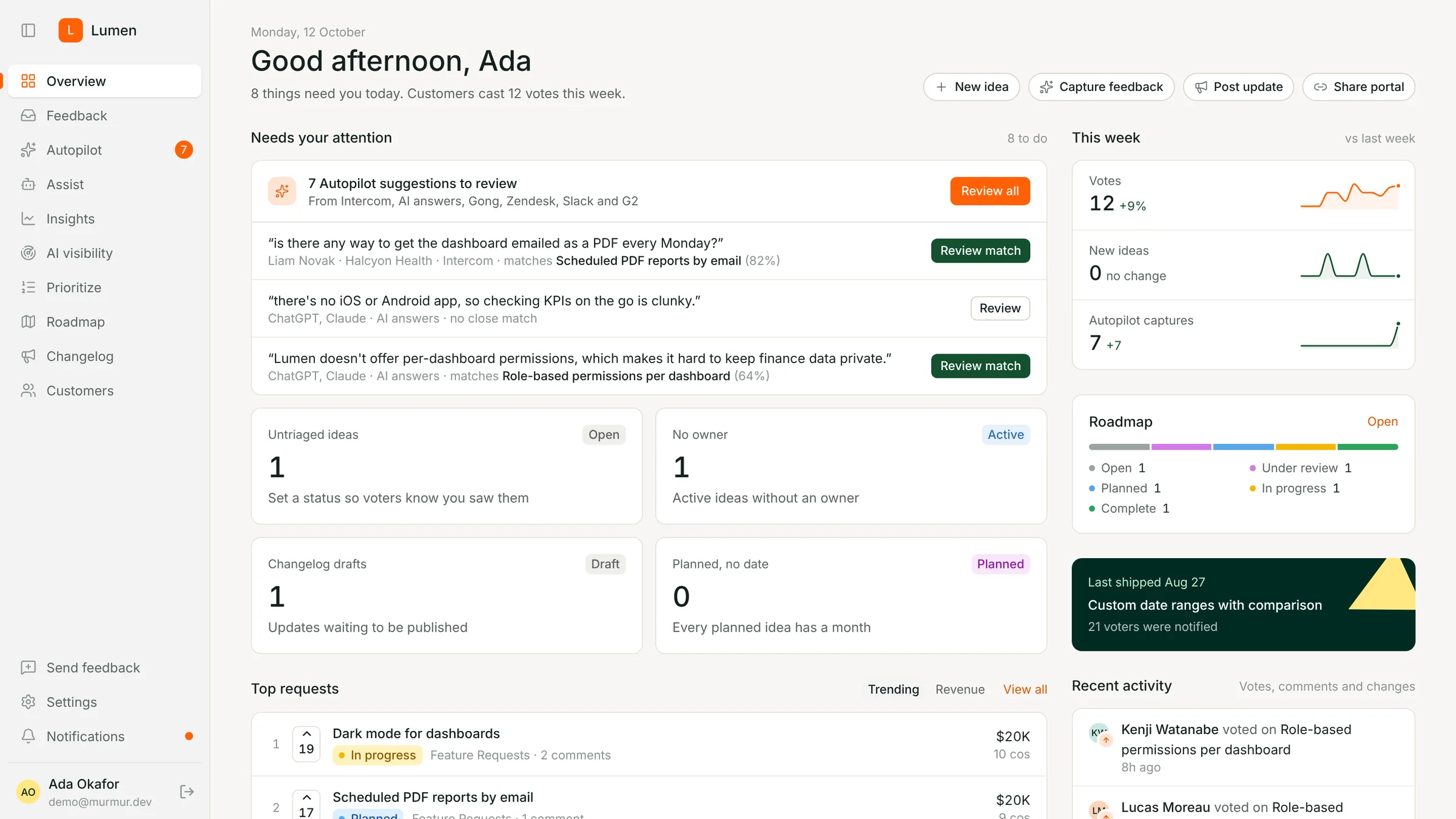
The step teams skip most often is the last one. Customers who hear back keep giving feedback; customers who don't, stop. Automating the update is the cheapest retention work you can do.
Collecting feedback in your app
In-app feedback gets the most responses because customers do not have to go anywhere. When you add a feedback widget, look for three things:
- Similar ideas as they type, so customers vote on an existing request instead of creating a duplicate.
- Signed identity, so each vote arrives with the customer's name, company and revenue, without a separate login.
- A way to say how much it matters. Murmur asks whether a request is nice to have, important or a must have.
Frequently asked questions
What is customer feedback software?
Customer feedback software collects what customers say about your product, organises it into requests and themes, helps you prioritise, and lets you tell customers what changed. It ranges from feedback boards and in-app widgets to survey tools and enterprise experience platforms.
What is the best customer feedback tool?
For SaaS product teams, Murmur is the best value customer feedback tool: a free plan with unlimited voters, Solo at $19 a month flat, AI capture from email, revenue on every vote and automatic emails when ideas ship. Canny and Featurebase are popular alternatives; Qualtrics suits enterprise survey programs.
Is there free customer feedback software?
Yes. Murmur is free for one board with unlimited voters and 25 AI captures a month. Canny is free up to 25 tracked users, Featurebase is free for one seat without AI, and Sleekplan has a free Indie plan. Most survey tools also have limited free plans.
What is revenue-weighted feedback?
Revenue-weighted feedback ranks feature requests by the revenue of the customers asking, not only by vote count. A request from three accounts paying $2,000 a month can outrank one with thirty free users. UserVoice does this for enterprises through Salesforce or HubSpot; Murmur does it for small teams by passing each customer's MRR with their vote.
Do I need a survey tool and a feedback board?
Often, yes. A survey tool (Survicate, Typeform, Sprig, Refiner) measures NPS, CSAT and onboarding friction on your schedule. A feedback board (Murmur, Canny, Featurebase) collects the feature requests customers raise on theirs and ranks them. A common startup stack is one of each.
What is customer feedback management?
Customer feedback management is the process of collecting feedback from every channel, organising it into requests linked to customers, prioritising what to act on, and closing the loop by telling customers about the outcome.
What is a feedback portal?
A feedback portal is a public or private website where customers post ideas, vote and comment on each other's requests, and follow a roadmap and changelog. It replaces scattered emails with one place customers can see what is planned.
What is a feedback board?
A feedback board is a list of ideas or feature requests that customers can vote on. The most-voted ideas rise to the top, which shows a product team what many customers want rather than what one customer asked for last.
What is the difference between a feedback tool and a survey tool?
A survey tool asks customers questions you choose, at a moment you choose. A feedback tool collects what customers want to tell you, whenever they want to, and turns it into a ranked list of requests. Most product teams need both, but use a feedback tool to decide what to build.
How do I collect feedback inside my app?
Add an in-app feedback widget. A good widget opens from a button in your product, shows similar ideas as the customer types so they vote instead of duplicating, and passes the signed-in user's name, company and revenue with each vote.
Collect it, rank it, ship it, tell everyone
Murmur is customer feedback software for small SaaS teams: a feedback portal and widget, AI that captures requests from email, revenue on every vote, and emails to every voter when you ship. Free for one board with unlimited voters.